
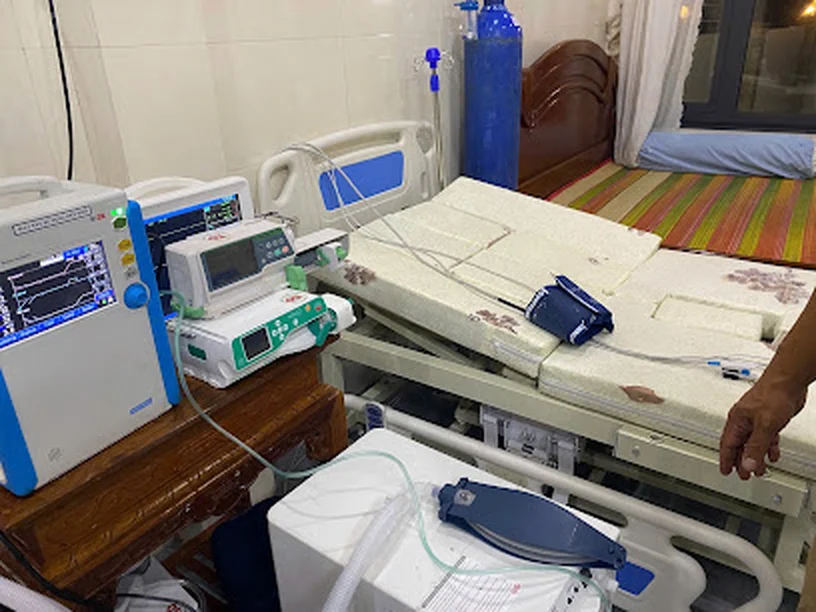
Almost nobody plans to be in a hospital in Dong Hoi. People come to this part of the country for the caves and the national park, and the city is usually a night before or after. But Dong Hoi is also the place with the hospital capacity for the whole area, and if something happens around Phong Nha, this is where you end up.
Before anything else
Call 115 for an ambulance, or go to the nearest emergency department, IMMEDIATELY for: severe difficulty breathing, chest pain, heavy bleeding, a head injury with drowsiness or vomiting, a suspected spinal injury, a seizure, or anyone who cannot be woken. In those cases distance and language come second to speed. Police is 113 and fire is 114 — Vietnam does not have a single combined emergency number.
The geography is the first thing to understand
The Phong Nha area and Dong Hoi are about 45 km apart, which is roughly an hour by road each way. That matters in two directions: it is why a serious injury in the park takes time to reach definitive care, and it is why a hospital visit from your accommodation in Phong Nha costs you most of a day.
The part people underestimate: the famous caves sit deep inside the national park, some of them 15 to 40 km from the nearest road, with no phone signal. Between an injury in there and a hospital in Dong Hoi there is a walk or a boat, then a drive. If you are doing a multi-day cave trip, ask the operator what their evacuation plan actually is — not whether they have one.
What there is in Dong Hoi
The main public hospital is the Vietnam – Cuba Friendship Hospital, a central-level public hospital given by Cuba and opened in 1981. For this part of the country it is the referral point, and it regularly receives foreign patients — which is not true of every provincial hospital. Some of its doctors work in English, Spanish or French. There are also smaller public facilities and private clinics in the city; what is available on a given day depends on the department and the staff on duty, so it is worth a phone call rather than an assumption.
| Situation | Where this usually goes | What to expect |
|---|---|---|
| Serious trauma, breathing or cardiac emergency | Emergency department, Dong Hoi — by ambulance (115) if needed | Speed first; interpretation sorted out afterwards |
| Fracture, deep wound, suspected concussion | Hospital in Dong Hoi for imaging and assessment | Expect a day; bring your passport and insurance details |
| Fever, stomach illness, infected graze, dehydration | Can usually be assessed where you are staying | Avoids an hour each way while unwell |
| Follow-up: dressings, injections, removing stitches | Where you are staying | This is the part that outlasts most bookings |
The thing foreign patients are least prepared for
Public wards in Vietnam are built on the assumption that a family member stays with the patient. A relative brings food, helps to the bathroom, watches the drip, calls the nurse, and translates. Staffing is planned around that. It is not neglect and it is not aimed at foreigners — it is simply how the system is organised.
If you are travelling as a couple, one of you absorbs that role and does not sleep. If you are travelling alone, there is nobody to absorb it. This is the single biggest practical difference between being admitted at home and being admitted here, and it is the gap an English-speaking caregiver at the bedside fills: being there overnight, translating what the doctor said, and telling you when something has changed.
Language, in practice
- Write a short timeline of what happened and your symptoms in English, and keep it on your phone — it survives shift changes better than a conversation does.
- List your regular medicines by active ingredient, plus any drug allergies.
- Keep the packaging of anything you have already taken, including what you bought at a pharmacy.
- Ask for the diagnosis and the treatment plan in writing, even briefly. It is much easier to translate a written line than to reconstruct a conversation later.
- Photograph every document as you receive it — invoices, test results, discharge notes.
After discharge is where the trip actually breaks
Discharge is not recovery. A wound that needs its dressing changed every two days, stitches that come out in ten, a course of injections, physiotherapy after a fracture — none of that fits a booking that was supposed to end on Thursday. The realistic options are to extend where you are and have the follow-up come to you, or to move to a city with more capacity and do it there.
- Dressing changes and wound review where you are staying
- Removing stitches or clips at the right day rather than the convenient one
- Injections and IV fluids by indication, with monitoring while they run
- Physiotherapy after a fracture or a soft-tissue injury
- An itemised invoice and a medical report in English for your insurance claim
Not sure whether this needs the hospital in Dong Hoi or can be handled where you are staying? Call +84 94 368 81 15 (24/7) or leave your details — asking and booking over the phone is free, and we confirm what is possible in your area before anyone sets out. This is not an emergency service: for the red flags above, call 115.
Insurance, while it is still easy
If you have travel insurance, call the assistance line on your policy early — the operator logs the case, tells you which facility to use and confirms whether they will pay the hospital directly. If you pay yourself and claim afterwards, you need an itemised invoice and a medical report in English stating the diagnosis, what was done and when. For a road or trekking accident many insurers also want a police report, which is a separate step at the police station (113) and not something the hospital issues. Collecting all of this after you have left the country is far harder than collecting it on the day.


