
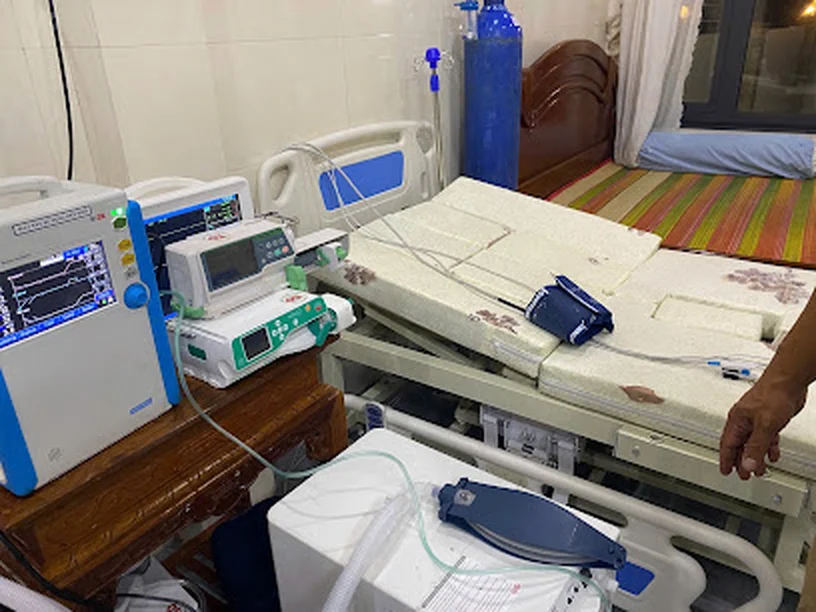
Most foreign patients in Hanoi arrive at a hospital in one of two ways: something happened on the road, or something that started as a hotel-room illness got past the point where staying in the room was sensible. Either way the decision gets made in a hurry, and the thing that determines how the next few days go is not which hospital has the best reputation — it is which of three quite different systems you have walked into.
Before anything else
Call 115 for an ambulance, or get to the nearest emergency department, IMMEDIATELY for: severe difficulty breathing, chest pain, heavy bleeding, a head injury with drowsiness or vomiting, a suspected spinal injury, a seizure, or anyone who cannot be woken. In those situations speed beats every other consideration, including language and cost. Police is 113 and fire is 114 — Vietnam has no single combined emergency number.
Three tiers, not one system
Hanoi holds a concentration of central-level public hospitals — facilities that take referrals from across the north of the country. They include a large general hospital in Dong Da, a surgical hospital in Hoan Kiem, a national paediatric hospital, a national geriatric hospital, and a national hospital for infectious and tropical diseases with campuses in Dong Da and out at Dong Anh. These are public institutions with deep specialist capacity. They are also busy, and they run on the assumptions described below.
Below that sit the city and district public hospitals, which handle the ordinary volume of a large city. And alongside both there are private and international hospitals and clinics. We do not name private facilities here, but the trade is consistent and worth stating plainly: they cost substantially more, they are far more likely to have English-speaking staff and an international patient desk, and some of them have direct billing arrangements with particular insurers. Whether that applies to your policy is a question for your insurer, not for the hospital reception.
| Situation | Where this realistically goes | What to expect |
|---|---|---|
| Road accident, major trauma | Nearest emergency department, by ambulance if needed | Treated first, paperwork later; ask the police for a report the same day |
| Fracture, deep wound, suspected concussion | Public hospital emergency department for imaging | Several hours; bring passport and insurance details |
| Fever that will not break, suspected dengue | Infectious disease capacity, or an assessment where you are staying | Bloods, often repeated over days to watch the platelet count |
| Chest or breathing problem getting worse | Emergency department — do not wait for morning | Winter air can tip an existing lung condition quickly |
| Ongoing condition, no emergency | Outpatient appointment, or a doctor to your accommodation | Bring your records; the consultation is short and the queue is not |
| Needs English and direct billing | Private or international facility | Confirm the billing arrangement with your insurer first |
What a public ward actually expects from you
This is the part that surprises people most, and it is not a failing of the hospital — it is how the system is designed. A Vietnamese public ward assumes that a family member is present with the patient: fetching food and water, helping to the bathroom, buying what the ward asks you to buy, watching for changes overnight and calling a nurse. Nursing staff do the clinical work; the rest is assumed to be covered by the family. Vietnamese families organise this without thinking about it, often in shifts.
If you are travelling alone, as a couple, or with someone who also needs looking after, that assumption becomes the real problem of the admission. One person cannot hold a bedside around the clock, deal with the paperwork in a language they do not read, and sleep. This is the single most common reason foreign patients in Vietnam have a bad hospital experience that had nothing to do with the medical care.
- Expect to be asked to buy items for the ward; keep every receipt, they are part of the claim
- Expect a deposit or a payment at the cashier before some steps proceed
- Expect the ward to be shared and noisy, and visiting hours to be interpreted generously
- Expect meals to be the family's job unless you arrange otherwise
- Do not expect an interpreter to appear; arrange for one, or write everything down in advance
Language: prepare it on paper
There is no guarantee of an English-speaking clinician on any given shift in a public hospital, and a translation app in an emergency department is slow and unreliable in both directions. What works is paper prepared in advance: your name and date of birth, your allergies, your current medicines with the generic names and doses, any ongoing conditions and past operations, your blood type if you know it, and your insurer with the policy number and the emergency line. Keep a photograph of it on your phone and a printed copy in your bag.
Money and paperwork, in the right order
In a public hospital the normal pattern for a foreign patient is to pay at the counter and claim afterwards. Bring a card and some cash — not every department takes a card, and card payment can fail at the moment you need it. The documents to collect are specific, and far easier to get while you are still in the building than by email a week later from another country.
- The itemised invoice — hóa đơn — not a total scrawled on a slip
- The discharge paper — giấy ra viện — which records the diagnosis and the dates
- A medical report or summary of the admission, ideally in English, stamped by the hospital
- Copies of the test results and imaging, including the films or a disc if there was a scan
- For a road accident, a police report — ask on the day, not after you get home
- Receipts for anything you were sent out to buy, including from the pharmacy at the gate
If you may need to fly home sooner than planned, tell someone early. A fit-to-fly assessment, a repatriation decision and an insurer's authorisation all take days, and Noi Bai airport is about 30 km north of the city, which matters for how a transfer gets organised. Insurers almost always want to be told before arrangements are made, not after.
Two things specific to Hanoi
The first is the particulate season, roughly October to March, when stagnant cool air holds pollution over the city for days. If you already have asthma, COPD or heart failure, Hanoi in February is a different environment from Hanoi in June, and a chest problem can escalate faster than you expect. The second is the traffic. Motorbike injuries are a frequent reason foreign visitors meet the Vietnamese hospital system, and the ones that turn into long admissions are usually the ones where nobody was wearing a helmet that fitted.
The part people fail to plan: after discharge
Wards here discharge earlier than many visitors expect, and the discharge is not the same thing as being able to travel. A wound that needs dressing every two days, injections that need giving on a schedule, a drain or a catheter to manage, physiotherapy to start — all of that lands on whoever is with you, in a hotel room, in a city where you do not read the labels. It is also, conveniently, the part that can be handled where you are staying rather than by going back to the hospital each time.
- A nurse at the bedside in hospital, in shifts, so one companion is not holding it alone
- Wound and dressing care at your accommodation after discharge, on the schedule the ward set
- Injections and IV treatment at home, given against the discharge prescription
- A doctor visit to review progress, and to say plainly whether you are ready to fly
- An itemised invoice and an English report for each visit, for the claim
In hospital in Hanoi, or just discharged and unsure how to manage the next two weeks? Call +84 94 368 81 15 (24/7) or leave your details — asking and booking over the phone is free, and we confirm what can be done where you are before anyone sets out. Y Tế Xanh has its own doctors and nurses in Hanoi, and a clinic in My Dinh if you would rather come to us. Not an emergency service: for the red flags above, call 115 or go to the nearest emergency department.


