
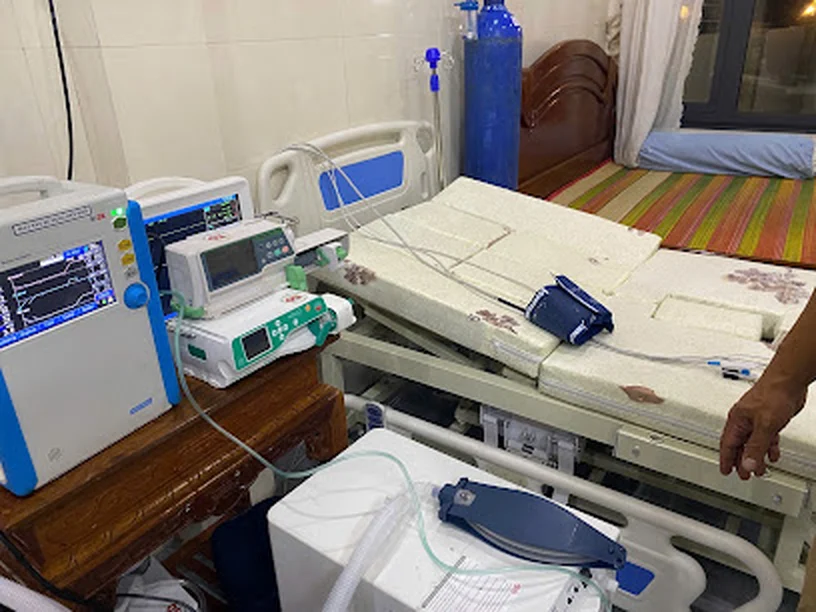
There is a particular kind of quiet that happens when you are admitted to a hospital in a country where you do not speak the language. Everyone around you is busy and competent. Forms arrive. Someone points at a corridor. And you realise that the thing you actually need — someone to tell you what is happening — is the one thing nobody has time to give you.
This page is about the public hospitals in Ho Chi Minh City, written for people who might end up in one. It is not a ranking and it is not an advertisement for avoiding them. It is what the experience is like, and what you can do about the parts that are hard.
First, the part that is not negotiable
If you have chest pain, difficulty breathing, uncontrolled bleeding, a head injury with confusion or vomiting, a seizure, sudden weakness on one side, or you cannot stay awake — call 115 or get to the nearest emergency department now. Do not read the rest of this page. Do not wait for anyone to arrange anything.
Everything below assumes you are past that point: either it was never an emergency, or the emergency has been dealt with and now you are in a bed wondering what happens next.
The public hospitals people search for, and what each one is
These are state hospitals. Several of them are national-level referral centres, which means the hardest cases in southern Vietnam are sent to them. If you are looking at these names because a doctor referred you, that referral is a good sign, not a bad one.
- Cho Ray Hospital — a large public general hospital with broad specialties and a heavy emergency and trauma load. Cases are referred to it from other provinces.
- Binh Dan Hospital — a public surgical hospital, covering general and urological surgery.
- Tu Du Hospital — a public hospital specialising in obstetrics and gynaecology, including newborn care.
- Hung Vuong Hospital — another public obstetrics and gynaecology hospital in the city.
- Gia Dinh People's Hospital — a large public general hospital serving the city, with an emergency department.
What these places share is depth of experience. A surgeon in a Vietnamese public referral hospital has seen an enormous volume of the condition you have. That is not a small thing, and it is the reason people travel to these hospitals from across the country.
So why is it hard?
Because the medicine is only part of what a hospital does, and the rest of it is built on an assumption that does not hold for you.
It is crowded, and crowding costs you time, not quality
Public hospitals in Vietnam are busy in a way that surprises most visitors. Corridors are full. Waiting is normal. Family members sit on the floor because there is nowhere else to sit. None of that means the care is poor — it means demand is enormous and the price is deliberately kept low so that people can actually use it. But it does mean nobody has fifteen minutes to explain things twice.
The working language is Vietnamese
Some doctors speak good English, particularly younger ones and those in referral centres. Many nurses do not, and nursing staff are the people you interact with hourly. Consent forms, medication instructions, discharge papers and billing are in Vietnamese. Translation apps handle a menu; they do not reliably handle a consent form for an operation.
The system expects a family member to stay
This is the part almost nobody warns foreign patients about, and it is the most important sentence on this page. In Vietnamese public hospitals, a relative normally stays with the patient — helping them to the bathroom, buying and preparing food, watching the drip, fetching a nurse when something changes, queueing for paperwork and pharmacy. Nursing staff handle clinical care; the rest is assumed to be covered by family.
If you are in Vietnam alone — travelling, working, retired here, or your family is on another continent — that role is not reduced. It is empty. And an empty bedside role in a busy ward is where small problems become large ones: the drip that finished twenty minutes ago, the pain that was not reported because you could not explain it, the fever nobody noticed at 3am.
The choice most people think they have, and the one they actually have
The usual framing is: cheap public hospital where nothing is explained, or expensive private international hospital where everything is in English. Presented that way, anyone with the money picks the second.
But that framing hides what you are actually paying for. In an international hospital you are buying two different things at once — the clinical care, and the service layer around it: English, a private room, someone who answers questions. The premium is mostly in the second thing. Meanwhile some of the deepest clinical expertise in the country sits in the public system.
There is a third option, and it is the one this article exists to explain: keep the public hospital, and hire the service layer separately.
Hiring a bedside nurse in a public hospital
This is a normal, established service in Vietnam. Families who both work hire someone to stay with an admitted relative. Foreign patients can use exactly the same service, with one addition that matters: a caregiver who speaks English.
What that person does through a hospital stay:
- Stays with you on the ward — by the hour, by the day, or overnight.
- Interprets when doctors and nurses come round, so you understand what was decided and they understand what you reported.
- Reads the paperwork with you before you sign it — consent, medication changes, discharge instructions.
- Handles the queueing: admissions, pharmacy, tests, payments.
- Helps with the ordinary things illness takes away — eating, washing, moving, using the bathroom after surgery.
- Watches for the things you would not know to watch for, and calls a nurse when they happen.
- Keeps your family updated in a language they read, which matters more than people expect when they are far away.
Our nurses and caregivers work in public hospitals in Ho Chi Minh City, and our doctors stay involved through the admission — reviewing what has been decided with you, and explaining it in English. You are not swapping your hospital team for ours. You are adding the layer the ward does not have time to provide.
One boundary worth stating plainly: a hired caregiver does not overrule your treating doctors and does not make clinical decisions. Their job is to keep you fed, clean, comfortable, understood, and monitored — and to get a nurse when you need one.
If you are having surgery and you are on your own
Surgery is where being alone stops being merely uncomfortable and starts affecting outcomes. Three specific points:
Before
You will be asked to sign consent, fast from a certain hour, stop certain medicines, and arrive at a certain time. Every one of those instructions arrives in Vietnamese, and getting one of them wrong can postpone the operation.
Immediately after
The first day or two after an operation is when you need someone most and can advocate for yourself least. You may be drowsy, in pain, attached to a drain or a catheter, and unable to get to a bathroom unaided. This is precisely the window the ward assumes a family member covers.
After discharge
Discharge in a busy public hospital often comes earlier than visitors expect, because beds are needed. You go back to a hotel room or an apartment with dressings to change, injections to continue, stitches to remove on a specific day, and a body that cannot yet do stairs. Recovery does not end at the hospital door — it moves to wherever you are staying.
That is the part we can carry all the way through: the same team that sat with you on the ward continues at your accommodation — wound care and dressing changes, prescribed injections and drips, stitch removal, mobility and physiotherapy support, and a doctor who reviews your progress until you are genuinely recovered rather than merely discharged.
What it costs, honestly
We are not going to print a comparison table of other hospitals' prices, because those change and quoting them would be guesswork. What we can say is the shape of it: public hospital treatment plus a hired English-speaking caregiver is dramatically cheaper than an equivalent stay in a private international hospital — the difference is a multiple, not a percentage. Nearly all of that saving comes from where you sleep and who brings you water, not from the quality of the surgeon.
We give a written quote before anyone starts, and we issue an itemised invoice you can submit to a travel insurer. If you would rather be treated in a private hospital, say so — we work in those too, and we will tell you plainly when we think the public hospital is the better clinical choice.
Practical notes for a public hospital admission
- Bring your passport. Admission and billing are tied to it.
- Contact your travel insurer early — many require notification within a set window, and an itemised invoice afterwards.
- Keep every piece of paper you are given, including pharmacy receipts.
- Photograph your regular medicines, including the boxes, before you need to explain them.
- Expect to pay as you go rather than at the end; keep a payment method accessible.
- Write down the name of your ward and bed number. It is harder to remember than you would think.
When you should not be in a hospital at all
The other half of the honest answer: plenty of the illnesses that ruin a trip do not need an admission. Food poisoning, dehydration, a fever that is unpleasant but stable, a wound that needs redressing, a course of prescribed drips — all of that can be treated where you are staying, by a doctor and a nurse who come to you. If you are unsure which situation you are in, that itself is a good reason to have someone look at you before you queue for four hours.
If you are getting worse rather than better — new confusion, breathing that feels harder, a fever that will not come down, pain that is escalating — stop weighing options and go to an emergency department.


