
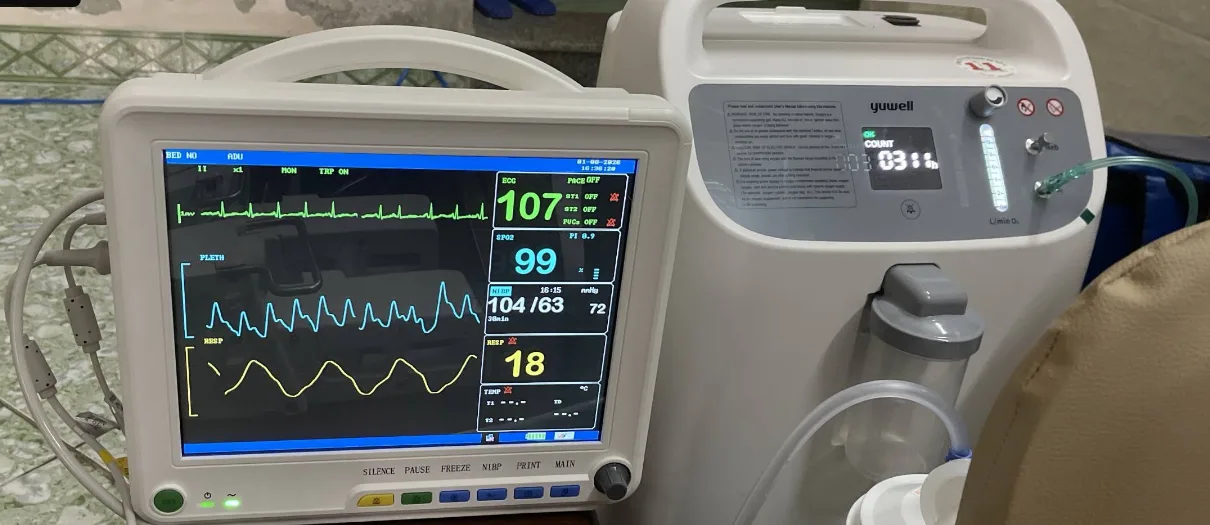
When the hospital says your relative can go home but will still need oxygen, a ventilator or a specialised bed, families usually have only a few days to get ready. This article sets out what has to be done in order of priority, so you do not end up buying in a hurry and still missing the thing that matters most.
Rent or buy?
| Criterion | Renting | Buying |
|---|---|---|
| Length of use | Short-term, or not yet known | Long-term use already certain |
| Up-front cost | Low | High |
| Maintenance and replacement on failure | Handled by the rental provider | The family's own responsibility |
| Switching type as the condition changes | Flexible | Difficult — you have to buy again |
In practice, a patient's condition in the first stage at home is still changing. Renting lets the family adjust as things develop instead of being locked into a device they have already bought.
The groups of equipment usually needed
- Oxygen supply: an oxygen concentrator for daily use, an oxygen cylinder as a reserve for power cuts or for moving the patient
- Respiratory support: a ventilator as prescribed, a suction machine
- An adjustable hospital bed, and a pressure-relieving mattress for anyone bedbound for long periods
- Monitoring: an SpO₂ meter, a blood pressure monitor, a thermometer, a blood glucose meter
- Mobility support: a wheelchair, a walking frame
What to prepare before the day your relative comes home
- Ask the treating team explicitly: which equipment is needed, what settings it runs at, which readings to watch.
- Check the electrical supply at home: a socket near the bed, whether the circuit can take the load, and what happens in a power cut.
- Arrange where the bed goes: enough room for a carer to work from both sides, close to the bathroom, well ventilated.
- Decide who is going to operate the equipment, and whether that person has been shown how.
- Keep the technical support number and a medical contact number to hand for anything unexpected.
Safety rules that are not optional
Oxygen makes a fire take hold extremely fast: absolutely no smoking, no open flame, no candles, no gas stove anywhere near where oxygen is in use. A ventilator and the oxygen level must be used exactly as prescribed — changing the settings yourself can cause harm. Always have a fallback plan for a power cut, especially for anyone dependent on continuous oxygen.
Equipment does not replace the person watching
This is the point families most often underrate. An SpO₂ meter produces a number, but knowing what that number means in this particular patient's situation, and when it is time to call a doctor, is a different thing altogether. For anyone on a ventilator or on continuous oxygen, having a nurse monitoring them at least through the first stage is what catches early signs of deterioration.
What the cost depends on
| Item | What the price is based on |
|---|---|
| Medical equipment rental (per day, by type) | Which device, and for how long — a day rate, a 15-day package and a 30-day package are priced differently |
| Home care for a ventilated patient | Nursing hours per day, and how severe the case is |
| Home nursing care (per day) | Hours per day, and how long the period of care runs |
| Doctor home visit (periodic review) | The appointment time, how serious the condition is, and the travel distance |
GreenCare rents out equipment together with instructions for use and technical support, and also has a home nursing team for cases that need professional monitoring. In Ho Chi Minh City, equipment and staff are arranged by schedule — so get in touch well before the discharge date. Every figure is confirmed with you before we begin.
In Ho Chi Minh City and need a doctor or nurse at your address? Call 094 368 81 15 — calling to ask a question or to book costs nothing. GreenCare has doctors who come to examine, nurses who carry out doctor's orders (injections, infusions, dressing changes), remote consultation by video call, and a review of the medicines you are taking; an in-depth remote consultation, or any one after the first, is a paid service. For children we take examination and acute care only — not long-term care at home, and not newborns or expectant mothers. GreenCare will confirm a time slot with staff available in your district and quote the price clearly before we begin.
Book services in Ho Chi Minh City
Y Tế Xanh has its own in-house team working in Ho Chi Minh City. See the services available there and book: Y Tế Xanh in Ho Chi Minh City.


